Wafric News – June 27, 2025
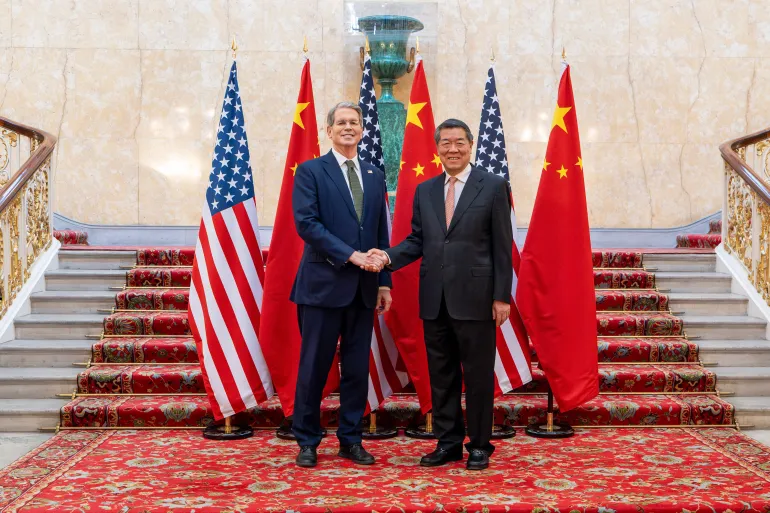
Beijing – China has officially confirmed the framework of a trade agreement with the United States, following months of tense back-and-forth over tariffs and strategic materials. The deal, shaped in high-level meetings in Geneva and London, marks a temporary easing of economic hostilities — but leaves many questions unanswered as global markets brace for further uncertainty.
According to China’s Ministry of Commerce, the agreement includes a commitment from the US to roll back “restrictive measures,” while Beijing will begin to process export control licences for rare earth elements — a crucial bargaining chip in the escalating tech and trade rivalry between the two superpowers.
Rare Earths at the Heart of Global Power Play
The negotiations were driven in part by Washington’s urgent push to secure access to rare earth minerals, which are indispensable for electric vehicles, advanced computing, military technology, and clean energy infrastructure. China controls over 70% of the global supply, and in April, it tightened its grip by requiring export licences — a move widely interpreted as retaliation against the Trump administration’s sweeping tariffs.
While both sides agreed during May’s Geneva talks to temporarily lower tit-for-tat duties, friction quickly resurfaced when US officials accused Beijing of dragging its feet on licence approvals. The London round of negotiations in June revived momentum, with both sides reaching a “framework to implement” their earlier consensus.
Washington Confirms, But Ambiguities Remain
A senior White House official confirmed the breakthrough on Thursday, shortly after former President Donald Trump told supporters at an event that the US had “just signed” a trade deal with China — though without providing details. Hours later, Beijing confirmed that a deal was in place.
“It is hoped that the United States and China will meet each other halfway,” China’s commerce ministry said in a carefully worded statement, noting that “both sides have further confirmed the details of the framework.”
Under the new arrangement, China will “review and approve applications for controlled export items that meet requirements in accordance with the law,” while the US will cancel a range of trade restrictions targeting Chinese goods and sectors.
Tariff Uncertainty Still Looms
Despite the deal, the global trade outlook remains fragile. A separate US policy deadline looms on July 9, when steeper tariffs on dozens of economies — paused earlier this year — are due to take effect unless a new round of negotiations yields results.
When asked about the possibility of extending the deadline, White House Press Secretary Karoline Leavitt said, “Perhaps it could be extended, but that’s a decision for the president to make. The deadline is not critical.”
She added that Trump maintains the power to impose “reciprocal tariffs” on countries that fail to present what he views as fair trade terms — a reminder that unilateralism remains a tool of US trade diplomacy.
Global South Watching Closely
While the deal may calm financial markets in the short term — with Asian and European stock markets rising Friday on hopes of further de-escalation — developing economies are watching warily. Many fear being caught in the crossfire of Sino-American power politics, where supply chains, resource access, and tariff regimes are shaped without their input.
For African, Latin American, and Southeast Asian countries rich in natural resources, the rare earths saga is a cautionary tale: control over strategic minerals is no longer just an economic issue — it’s a geopolitical weapon. As China and the US spar over who gets what and at what cost, the Global South must ask: Who will ensure fairness in a world where economic muscle still defines the rules of the game?
WafricNews will continue monitoring developments around this evolving trade realignment.
By WafricNews Desk.


Comment
To post a comment, you have to login first
LoginNo Comments Yet...