Japan Embarks on ‘World-First’ Deep-Sea Mining Mission Amid Global Scramble for Critical Minerals
By Nia Kwame - Business - July 3 2025
Wafricnews - July 3, 2025
Tokyo - In what could mark a new chapter in the global race for critical resources, Japan is set to become the first country to launch a deep-sea mining operation at unprecedented ocean depths, testing technologies that could shift both economic and ecological fault lines.
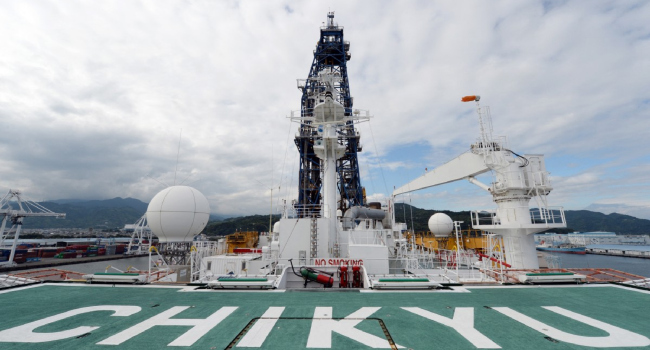
Beginning in January, Japan will deploy the deep-sea drilling vessel Chikyu on a mission to extract rare earth-rich mud from the seafloor at depths of 5,500 meters the deepest trial ever attempted for this type of mining.
The venture, led by Japan’s Cross-ministerial Strategic Innovation Promotion Programme, is part of a broader strategic effort to secure access to key minerals vital for everything from electric vehicles to military hardware. According to programme director Shoichi Ishii, the main objective is to test the functionality of mining equipment rather than to yield significant mineral output.
“Our goal… is to test the function of all mining equipment,” said Ishii. “The volume of sediment extracted doesn’t matter at all.”
The drilling will take place within Japan’s exclusive economic zone, around the remote island of Minami Torishima a strategic Pacific outpost also used for military purposes.
This picture shows the drilling tower from a heli-port located on the front section of Japan’s deep-sea drilling vessel Chikyu as it anchores at a pier in Shimizu port, Shizuoka prefecture on September 11, 2013.
A New Mineral Frontier and a New Geopolitical Flashpoint
Japan’s announcement comes just days after it pledged to strengthen mineral supply chains alongside the United States, Australia, and India a bloc increasingly wary of China’s dominance in rare earth processing.
China currently controls nearly two-thirds of global rare earth mining and over 90% of refining capacity, according to the International Energy Agency. This dominance has raised alarms in Washington and other capitals, especially as rare earths are indispensable to clean energy technologies, precision-guided weapons, and digital infrastructure.
Beijing, in turn, has tightened its grip. Since April, China requires special export licences for rare earth shipments a move widely interpreted as a response to U.S. trade restrictions.
Deep-sea mining, once the stuff of science fiction, is now seen by many developed economies as a way to break China’s stranglehold on critical resources. But this vision has sparked fierce debate.
At What Cost?
While Japan’s trial is restricted to its own waters, critics warn that it sets a dangerous precedent. Environmental groups caution that disturbing the ocean floor, particularly at extreme depths, risks irreversible damage to marine ecosystems many of which remain poorly understood.
“We’re entering a dangerous era where desperation for minerals may outweigh our responsibility to the planet,” said one ocean conservation advocate, speaking to WafricNews.
Each tonne of extracted mud is estimated to contain around two kilograms of rare earth minerals particularly valuable for producing high-performance magnets used in electronics, wind turbines, and electric motors.
Japan’s Nikkei business daily reported that the mission aims to extract up to 35 tonnes of seabed mud during a three-week test cruise.
Global Governance Lags Behind
The mission takes place amid mounting global tensions over the governance of international waters. The International Seabed Authority (ISA), the UN-affiliated body responsible for regulating mining beyond national jurisdictions, is expected to meet later this month to discuss a long-delayed mining code.
However, critics argue that the ISA has failed to uphold precautionary principles and is under pressure from powerful states and mining interests.
While countries like Japan and the U.S. eye the deep ocean as a new resource frontier, nations across the Global South many with their own ecological stakes are calling for a moratorium until more is understood about the risks.
Africa and the Global South: Watching Closely
For many African nations, this development comes at a time when mineral-rich countries are already grappling with extractive industries that have brought uneven development, ecological degradation, and debt dependency.
As deep-sea mining becomes a new theatre of resource competition, questions arise: Will the benefits go to the same handful of tech and industrial powers? Will communities in the Global South many of which border key oceanic routes be consulted, protected, or simply bypassed again?
WafricNews will continue to track the impacts of deep-sea extraction, not just in Japan, but across the world’s oceans where the future of resource security, environmental sustainability, and economic justice increasingly collide.



Comment
To post a comment, you have to login first
LoginNo Comments Yet...